The truth behind viral padel rules videos and common misconceptions
The creator from Mejora Tu Padel dives into some of the most viral and controversial padel rules videos circulating online. Many of these clips spark heated debates among players, with some even originating from the channel itself. The reviewer’s goal is to clarify these situations, separating fact from fiction and explaining the real logic behind the rules that often confuse both amateur and experienced players.
Understanding the net rule: who loses the point when the net is touched?
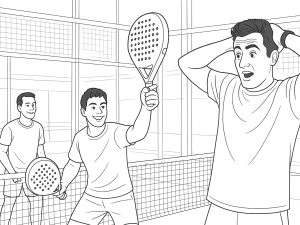
One of the most debated scenarios involves a player hitting the ball hard against the net, which then rebounds and touches the opponent before bouncing on the ground. The question: who loses the point? According to the reviewer, the answer is clear in the official regulations. The net is considered a neutral element—it has no sides. The point does not end when the ball hits the net, but only when the ball bounces outside the valid playing surface.
If a player touches the net, or the net touches the player, before the ball has bounced on the ground, that player loses the point. It does not matter if the contact is accidental or seems unfair; the rule is strict. The reviewer emphasizes that while this rule may seem “absurd” to some, its logic is consistent with the principle that the net must remain untouched during play. This clarification helps settle many disputes that arise from such rare but dramatic moments on court.
Interrupted serves: what happens when a ball enters the court between serves?
Another frequent source of confusion is what happens if, between a first and second serve, an external ball rolls onto the court. Many players instinctively believe the server should be granted a new first serve, arguing that the interruption resets the point. However, the reviewer explains that the correct procedure is to continue with the second serve.
This interpretation is supported by most referees, though the reviewer notes that there is some room for discretion depending on the timing and the referee’s judgment. If the server has not yet begun their pre-serve routine, the interruption does not reset the serve count. Only if the ritual has started and is interrupted would the entire point be replayed. This nuanced explanation highlights the importance of understanding both the letter and the spirit of the rules.
The legality of Martín’s serve and the diagonal serve interpretation
The reviewer addresses a trending topic: the legality of serves performed by top player Martín. Specifically, there is debate about whether his serve, which sometimes appears to be delivered from the wrong side or not diagonally enough, should be considered a fault. The channel clarifies that, according to current regulations and referee interpretations, Martín’s serve is legal as long as:
- The server’s feet are on the correct side (even or odd, as appropriate)
- The ball is bounced on the correct side before serving
- The serve travels diagonally into the correct service box
The reviewer points out that it is nearly impossible to measure with precision whether a serve is perfectly diagonal or slightly parallel. Referees generally interpret the rule flexibly, allowing for some margin as long as the intention and basic requirements are met. This pragmatic approach explains why Martín’s serve, and similar serves by other professionals, are not called faults in official matches.
Leaving the court: when is it allowed and what counts as outside play?
Another scenario analyzed involves a player hitting the ball and then leaving the court, especially in clubs where external play is not permitted. The reviewer explains that in most amateur clubs, outside play is prohibited for safety reasons, as courts are often placed close together with minimal space between them. The key distinction is that “outside play” refers to playing the ball while outside the court, not simply stepping out after a shot.
If a player strikes the ball while still inside the court and then exits, the point is valid. However, if the player attempts to play the ball after it has crossed the boundary, and outside play is not allowed, the point is lost. This clarification helps players understand why professional matches sometimes feature spectacular plays outside the court, while most club matches do not permit such actions.
Changing sides for the return: when is it legal to switch?
The final and most controversial situation discussed involves a player switching sides to return serve at the start of a set. The reviewer explains that, according to the rules, players can choose which side to return from at the beginning of each set, before the first return is made. Once a player has returned serve from a particular side, they must continue on that side for the rest of the set.
This means that the “trick” of switching sides for a tactical advantage is only legal during the very first point of a set, before any return has been made. After that, the sides are fixed. The reviewer notes that while this rule is sometimes misunderstood, it is well established in the regulations and is enforced in both amateur and professional play.
Key takeaways from the most debated padel rules
- Touching the net (or being touched by it) before the ball bounces results in losing the point.
- Interrupted serves due to external balls do not reset the serve count unless the pre-serve ritual has begun.
- Diagonal serves are interpreted flexibly by referees; intent and basic positioning matter most.
- Leaving the court is only penalized if the ball is played outside the court where external play is not allowed.
- Switching return sides is only legal at the start of each set, before the first return.
The reviewer’s analysis offers clarity on these rarely encountered but highly debated rules, helping players avoid unnecessary disputes and focus on enjoying the game.