Slinger Bag ball machine (Blue model) features and design overview
Note: This review refers to the standard Slinger Bag model. PadelSlinger has since released a Green model specifically designed for padel.
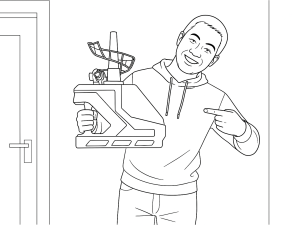
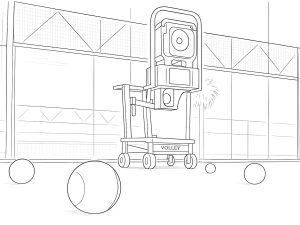
The reviewer begins by highlighting the main features of the Slinger Bag ball machine, focusing on its design and included accessories. The machine is described as compact and easy to transport thanks to its wheels and handle. It offers a generous ball capacity of around 140 balls, though the reviewer typically loaded about 90 balls with plenty of space remaining. The Slinger Bag comes with a remote control for convenient operation from across the court, allowing players to start and stop the machine without returning to its side. Additional features include USB charging ports for devices, a compartment for storing a small laptop or tablet, and a mobile phone holder for recording sessions.
Another notable accessory is the ball collection tube, which is longer than standard tubes and can be disassembled for easier storage. The machine also includes a rotating base that enables it to shoot balls to different sides of the court, simulating more dynamic play. The reviewer notes that the internal controls allow for adjustments to ball speed, spin, and launch angle, and the rotating base connects magnetically to the machine’s underside—though users should be careful to remove the protective cap before connecting, as failing to do so prevents proper contact.
- Ball capacity: 140 balls
- Remote control: Included
- Rotating base: Yes, with magnetic connection
- Ball collection tube: Extra-long, disassemblable
- Device charging: USB port available
- Mobile holder: Integrated
Performance issues for padel training
Despite its appealing features, the reviewer’s main criticism is that the Slinger Bag is not suitable for padel. The core issue is the machine’s inability to deliver balls without heavy topspin (liftado). Even when the spin is set to the minimum and the speed is reduced, every ball is launched with significant topspin. This makes it extremely difficult to practice padel strokes, as the balls react unpredictably off the racket, often flying out of control. The reviewer emphasizes that this persistent topspin is present regardless of the settings, especially when the machine is placed at the back of the court and the power is increased.
This limitation means that the Slinger Bag cannot be used effectively for practicing key padel shots such as volleys, bandejas, or smashes. The reviewer found that, instead of helping to improve technique, the machine’s delivery made it harder to control the ball and even posed a risk of injury, as players must counteract the excessive spin with forceful, unnatural strokes. The reviewer had intended to use the machine for both personal training and racket reviews, but after two sessions, found it unusable for these purposes.
Comparison with tennis and padel-specific machines
According to the reviewer, the Slinger Bag is well-suited for tennis due to the larger court size and the nature of tennis strokes, which often involve topspin. For tennis players, the machine’s power and spin capabilities are seen as advantages. However, the reviewer stresses that padel requires a different approach, with much greater emphasis on slice (cortado) and flat shots. The Slinger Bag’s inability to produce sliced or flat balls is a major drawback for padel training.
The reviewer also mentions having contacted the manufacturer, who confirmed that the standard Slinger Bag is not designed for padel. The company reportedly developed a padel-specific ball machine after recognizing these limitations. The reviewer expresses interest in testing this dedicated padel model in the future, but for now, advises against using the standard Slinger Bag for padel practice.
Practical experience and final assessment
The reviewer’s experience with the Slinger Bag was ultimately disappointing for padel use. Despite the machine’s robust build, user-friendly controls, and versatile accessories, its ball delivery is fundamentally incompatible with padel training needs. The reviewer notes that while the machine functions perfectly from a technical standpoint, its persistent topspin undermines its utility for padel players. For those seeking to improve their padel technique—especially for shots like the bandeja, volley, or smash—the Slinger Bag is not recommended.
For tennis players, however, the machine remains a viable option, offering ample power and the ability to practice topspin-heavy strokes. The reviewer found the lowest price for the Slinger Bag at €1,100, but cautions padel enthusiasts to look elsewhere or consider padel-specific models.
Reviewer’s ratings and recommendations
- Suitability for padel: 1/5 (not recommended)
- Suitability for tennis: 4/5 (recommended)
- Build quality and features: 4/5
- Value for padel players: 1/5
The reviewer concludes that, while the Slinger Bag is a well-made and thoughtfully designed ball machine, it is not a good investment for padel players. Those interested in ball machines for padel should seek out models specifically engineered for the sport, ideally with the ability to deliver a variety of spins and shot types. The reviewer plans to continue searching for a suitable padel ball machine and encourages others to share their experiences with different models.