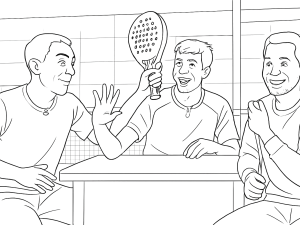
Fernando “Bela” Belasteguín reflects on a legendary padel career and sport evolution
The channel’s interview with Fernando “Bela” Belasteguín offers a rare, in-depth look at the mindset and journey of the sport’s most decorated player. With 16 years as world number one and over 230 career titles, Bela’s story is one of organic growth, relentless adaptation, and a deep passion for padel. He began playing at age 10 in his hometown, quickly transitioning from football to padel as the sport’s first courts appeared locally. By 15, he was already competing professionally, though he describes those early years as a natural progression rather than a calculated pursuit of greatness.
Bela’s move from Argentina to Spain marked a turning point, driven by his desire to compete against the very best as the professional scene shifted to Europe. He emphasizes that his longevity at the top was possible only through constant adaptation—both to the sport’s evolving demands and to his own changing physical capabilities.
Adapting to change: courts, equipment, and the modern game
Over three decades at the elite level, Bela has witnessed—and embraced—significant changes in padel. He recalls starting on cement courts and adapting as surfaces, equipment, and the pace of play evolved. The reviewer highlights Bela’s philosophy: to remain competitive, a professional must anticipate and adapt to every shift in the sport, from court technology to ball speed.
In recent years, Bela notes the game has become markedly faster, with quicker balls and more dynamic movement required. This acceleration, he admits, coincided with the natural slowing of his own reflexes and speed, making it increasingly challenging to maintain a top-ten ranking. Yet, he frames these changes as inevitable and even healthy for the sport’s progression.
Padel’s global growth and the United States opportunity
The creator explores with Bela the explosive growth of padel worldwide. Once concentrated in Argentina and Spain, the sport now enjoys a much broader reach. Bela credits the rise of social media for accelerating global awareness, but he is quick to point out that, despite progress, padel is still in its infancy in many regions.
Focusing on the United States, Bela sees enormous potential, especially in South Florida where the sport is gaining traction. He likens padel’s current stage to a baby just beginning to crawl, with a long journey ahead before it can “run the hundred meters.” Bela is confident, however, that padel will become a major global sport within the next decade.
Interestingly, he views the rise of pickleball in the U.S. as a positive force, predicting that many pickleball players will eventually transition to padel, further accelerating its growth. He advocates for hybrid clubs that offer both sports, emphasizing their complementary nature rather than competition.
The Bela Padel brand and international club expansion
Bela discusses his vision for the Bela Padel Center brand, which began as a concept during the pandemic and materialized with the opening of a flagship club in Alicante. The project serves as a “laboratory” for his methodology and philosophy, with plans to expand globally once a major center opens in Barcelona.
He stresses the importance of learning through experience—testing ideas, making mistakes, and refining the model before scaling up. The ultimate goal is to establish Barcelona as the headquarters and then bring the Bela Padel Center concept to markets like the United States, always prioritizing what is best for the sport’s sustainable growth.
Exhibition events, the Premier Padel League, and player prestige
Turning to the competitive landscape, Bela shares his perspective on the proliferation of new formats such as the Premier Padel League (PPL), Hexagon Cup, and other exhibition events. He believes these tournaments are valuable for promoting padel and attracting new audiences, especially in emerging markets like the U.S. and India.
However, Bela distinguishes between the prestige of ranking-based circuits, like Premier Padel, and the financial incentives of exhibition events. For him, true status comes from being number one in the official rankings, not from isolated event victories. He supports a balanced approach, where both exhibition and ranking events coexist to maximize the sport’s visibility and credibility.
Financial realities and the professional padel ecosystem
The channel probes into the economics of professional padel, and Bela provides a candid breakdown of player earnings:
- Rank 1: Up to $4 million annually
- Rank 10: Around $1.5 million
- Ranks 11–20: $1.5 million to $800,000
- Lower ranks (20+): Decreasing figures, with young players often earning much less
He notes that prize money has increased exponentially in the past three years with the advent of Premier Padel, but emphasizes the need for continued growth and fair distribution among players and organizers. Bela also addresses the role of sponsorships and social media, asserting that while online presence can help, nothing replaces the value of winning on court. He encourages aspiring pros to focus on training and results rather than follower counts.
Miami’s Premier Padel event and the importance of indoor venues
Bela expresses excitement about organizing the first Premier Padel tournament in Miami, viewing it as a pivotal moment for the sport’s expansion in North America. The event will be held at the Miami Beach Convention Center, with a capacity of approximately 1,700 spectators (1,300 in the stands and 400 in boxes). He explains the decision to keep the tournament “boutique” in scale for the first few years, prioritizing quality and community engagement over rapid expansion.
He also highlights the advantages of hosting the event indoors—eliminating issues with wind, rain, and humidity that have affected previous outdoor tournaments in Miami. This controlled environment, he believes, will provide a better experience for both players and fans, setting a standard for future events in the region.
Partnership with Wilson and the future of padel equipment
The interview concludes with Bela reflecting on his partnership with Wilson, a brand he admires for its leadership in racket sports. He is deeply involved in the development of his own line within the Wilson umbrella, aiming to make it the number one padel brand globally. With more time available post-retirement, Bela plans to work closely with engineers to refine and expand his product collection, ensuring it meets the evolving needs of players worldwide.
Key takeaways from Bela’s insights on padel’s future
- Adaptation is essential: The sport and its players must continually evolve to stay competitive.
- Global growth is accelerating, but padel remains at an early stage in many markets, especially the U.S.
- Hybrid clubs and complementary sports like pickleball can drive participation and awareness.
- Prestige comes from rankings, not just event wins or social media presence.
- Investment in infrastructure and quality events will be key to padel’s sustained expansion.
Bela’s vision, experience, and ongoing commitment to the sport position him as both a legendary player and a driving force behind padel’s global future.