Practical corrections for volleys at the net
The reviewer from Mejora Tu Padel focuses the session on improving net play, specifically the volley, bandeja, and víbora with real students on court. The initial emphasis is on the importance of a short backswing when volleying. Many amateur players tend to bring the racket too far back, which leaves them vulnerable to quick changes from opponents and often results in mishits or balls floating too high, making them easy targets for lobs.
To address this, the channel advises players to keep the racket in front, presenting it almost like a mirror facing the intended target. The movement should be compact, with the body weight moving forward to guide the ball. The reviewer repeatedly corrects students to avoid excessive wrist action and to use the body rather than just the arm for power and control. This approach ensures that volleys stay low and pressurize the opponent, rather than giving them easy opportunities to counterattack.
Key technical reminders for effective volleys include:
- Short backswing: Keep the racket close to the body, avoiding large preparatory movements.
- Controlled finish: Extend the follow-through forward, not upward, to keep the ball low.
- Body alignment: Use shoulder rotation and step into the shot to direct the ball, rather than relying on the arm alone.
- Consistent racket face: Present the face of the racket towards the target, avoiding excessive opening or closing of the wrist.
The reviewer stresses that adding more speed to the volley does not necessarily make it more difficult for the opponent. Instead, a well-placed, low ball is often more effective at the net.
Adjusting technique and mindset for net pressure
Throughout the training, the channel highlights a common misconception: players often believe that being at the net means they must finish the point with power. Instead, the focus should be on applying pressure and waiting for the right opportunity to finish. The reviewer encourages students to “suffocate” the opponent by keeping balls low and controlled, rather than trying to “kill” every volley.
This shift in mindset helps players understand that the volley is primarily a shot of pressure, not definition. By keeping the ball low and close to the net, opponents are forced to play up, increasing the chances of a weak return or an error.
Transitioning from this concept, the reviewer uses practical corrections, such as adjusting body orientation and encouraging players to use their non-dominant hand for balance. These small changes help students maintain better control and consistency during fast exchanges at the net.
Technical focus on the bandeja: arm position and preparation
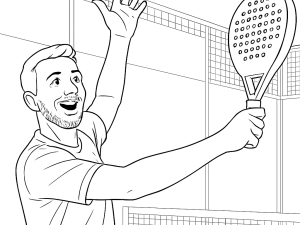
When moving to the bandeja, the reviewer pays special attention to arm and elbow positioning. Many players tend to drop their elbow during preparation, which leads to an upward, floating trajectory that is easy for opponents to attack. The correction is to keep the elbow high throughout the motion, allowing for a more direct and controlled shot.
Another key point is racket preparation. Instead of bringing the racket from below and whipping it upwards, the reviewer suggests a more compact, volley-like preparation. This helps maintain pressure and control, preventing the ball from floating and giving opponents time to react.
- Elbow position: Keep the elbow elevated to enable a straight, forward motion.
- Compact swing: Avoid excessive backswing or whipping motion; treat the bandeja more like a volley from above.
- Racket face: Ensure the racket face is slightly closed to avoid sending the ball too high or out of control.
These technical cues are reinforced with real-time feedback and video analysis, helping students see the difference between their perception and actual execution.
Common mistakes and practical drills for improvement
The reviewer identifies several recurring mistakes among students:
- Overusing the wrist: Leading to inconsistent contact and floating balls.
- Excessive power: Attempting to finish points too early, resulting in errors or easy lobs for opponents.
- Poor body alignment: Not stepping into the shot or misaligning the body, which affects direction and control.
- Dropping the elbow on the bandeja: Causing the ball to rise and lose pressure.
To address these, the channel demonstrates specific drills, such as practicing volleys with the non-dominant hand behind the back to encourage proper body rotation and compact swings. For the bandeja, students are asked to maintain a high elbow and focus on a short, controlled movement, treating the shot as a pressure tool rather than a finishing blow.
These practical corrections are designed to be immediately applicable, helping players of all levels improve their net game in real match situations.
Key takeaways for immediate application on court
Summarizing the session, the reviewer emphasizes several actionable points for players looking to improve their volley, bandeja, and víbora:
- Keep all net shots compact, with minimal backswing and a focus on body movement.
- Use pressure and placement rather than power to control the net.
- Maintain a high elbow and compact preparation for the bandeja to avoid floating balls.
- Pay attention to body alignment and use the non-dominant hand for balance and orientation.
- Regularly review your technique, either through video or feedback, to ensure your perception matches your execution.
By integrating these corrections and drills into regular practice, players can expect to see immediate improvements in their ability to control the net and apply pressure during matches.