Understanding rough surfaces in padel rackets and their impact on spin
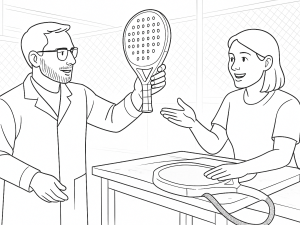
The reviewer from the4Set explores the ongoing debate in the padel community: does the rough surface on a padel racket truly enhance spin, or is it mostly a myth? To answer this, the channel visits the StarVie offices and consults with Felipe de la Roa, a product engineer at StarVie, to analyze five different types of roughness found in modern padel rackets.
Roughness, as explained by the engineer, refers to the uneven texture applied to the racket face. This can be achieved through various manufacturing techniques and surface designs, each influencing the racket’s ability to generate spin and, in some cases, the overall feel and hardness of the racket. The reviewer sets out to test and compare these finishes, focusing on both their tactile qualities and their real-world performance on court.
Examining the five main types of roughness in StarVie rackets
The channel systematically reviews five distinct roughness types, ranging from completely smooth faces to highly textured surfaces. Each type is linked to specific StarVie models and manufacturing methods:
- Smooth surface (no roughness): Found on models like the StarVie Alien, this type relies solely on the hole pattern for spin. The reviewer notes that with these rackets, generating spin depends entirely on player technique, with no extra assistance from the surface texture.
- Decal-based roughness: Present on rackets like the Titania, this is a 3D effect applied via the racket’s design decal. While it can be felt to the touch, the reviewer and StarVie engineer agree that it offers minimal practical benefit and tends to fade over time, providing little to no extra grip on the ball.
- Mold-based roughness (Full Plane Effect, small stars): This finish is directly integrated into the mold, making it durable and more effective. The reviewer finds the small, closely packed stars offer a noticeable improvement in spin compared to decal-based roughness, though it’s not the most aggressive option available.
- Mold-based roughness (Full Plane Effect, larger stars): An evolution of the previous type, this finish features larger and more widely spaced stars. Theoretically, it should provide even more grip and spin, but the reviewer is surprised to find that the difference is not as significant as expected during play.
- Hex Tech roughness: Featured on the StarVie Kenta, this is the most pronounced and tactile roughness tested. The hexagonal pattern covers all angles, ensuring consistent grip and spin regardless of shot type. The reviewer describes it as extremely noticeable both to the touch and during play, and it does not fade over time.
On-court testing: how each roughness type performs in real play
To move beyond theory, the reviewer takes each racket onto the court, performing a series of “vivora” (side spin) and drop shot tests. The goal is to feel and compare the impact of each roughness type on spin generation and shot control.
With the smooth-faced racket, the reviewer immediately notices the absence of assistance—the outcome of spin shots depends entirely on personal technique. The decal-based roughness on the Titania is similarly underwhelming, with the reviewer stating it feels almost identical to the smooth racket and offers no real advantage.
The first significant improvement comes with the mold-based small star roughness. Here, the reviewer feels a clear difference, with the surface providing extra grip and making it easier to impart spin. This version earns a rating of 7 out of 10 for its effectiveness in generating spin.
Surprisingly, the mold-based large star roughness does not deliver the expected leap in performance. Despite the stars being bigger and more spaced apart, the reviewer finds that it does not translate into more spin or grip during play, resulting in a sensation similar to the previous version.
The standout performer is the Hex Tech roughness on the StarVie Kenta. The reviewer praises its tactile feel, audible feedback, and the significant improvement in spin. The surface is described as “extremely noticeable,” and the reviewer awards it a rating of 9 out of 10, calling it the best roughness tested and wishing more rackets featured this kind of finish.
Comparing favorite rackets and final impressions on roughness effectiveness
After extensive testing, the reviewer identifies the StarVie Dronos (with small star roughness) and the StarVie Kenta (with Hex Tech) as personal favorites. Although the Raptor model offers a theoretically superior finish, the reviewer prefers the feel and performance of the Dronos and especially the Kenta.
In a final drop shot challenge, the reviewer confirms that the Kenta’s Hex Tech roughness provides the most confidence and ability to generate spin, especially on difficult shots. The difference in roughness height and pattern between the Dronos and Kenta is cited as the main factor behind this performance gap.
- StarVie Dronos (small star roughness): 7/10 for spin effectiveness
- StarVie Kenta (Hex Tech roughness): 9/10 for spin effectiveness
The reviewer concludes that while some roughness types are largely aesthetic or fade with use, mold-based finishes—especially the Hex Tech—offer tangible benefits for players seeking more spin. The choice of roughness can influence not only spin but also the overall feel and hardness of the racket, making it a key consideration for players looking to optimize their game.