Understanding effective net positioning for padel attack
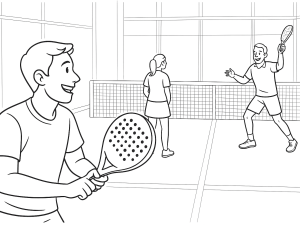
The reviewer, guided by Mauri Andrini, emphasizes that true attacking in padel is not simply about standing as close to the net as possible. Many players mistakenly believe that being right up against the net increases their offensive potential. However, the channel demonstrates that this position actually limits reaction time and exposes the court to opponents. The optimal net position is typically 3.5 to 4 meters away from the net, allowing players to execute shots with proper technique and maintain balance between offense and defense.
Standing too close—around 2 meters from the net—forces players into a blocking mode, reducing their ability to react to lobs or angled shots. This position also makes it difficult to perform a split step and impact the ball in front, which is crucial for effective volleys and smashes. By maintaining the recommended distance, players can better anticipate their opponents’ shots and transition smoothly between attack and defense.
Building the point before going for the winner
One of the core lessons from the session is the importance of constructing the point rather than rushing to finish it. The reviewer is encouraged to be more aggressive but is reminded that winning points in padel often requires patience and tactical buildup. Instead of attempting a winner at every opportunity, players should focus on gaining a strong position at the net and using a variety of shots to create openings.
Andrini explains that even professional players like Sanyo Gutiérrez sometimes play slightly further back from the net to set up their attacks. This approach allows for better coverage and more time to respond to deep lobs or unexpected returns. The key is to recognize when to move forward for a decisive volley and when to stay back and prepare for a transition shot.
Choosing between vibora, bandeja, and smash in attack
The video addresses a common question: when should players use a vibora, bandeja, or smash? The creator clarifies that the choice depends on the situation and the quality of the opponent’s lob. For example, if the lob is short and the player is well-positioned, a smash or aggressive shot may be possible. If the lob is deeper, a bandeja or vibora is often more effective for maintaining net control and buying time to recover position.
Practicing a range of shots—such as bandejas to the middle, parallel bandejas, and viboras—helps players develop the versatility needed to adapt to different scenarios. The reviewer is advised to train both parallel and cross-court lobs, as well as slow and fast variations of the bandeja. This variety keeps opponents guessing and prevents predictability in attack.
- Vibora: Best for buying time and recovering net position after a deep lob.
- Bandeja: Effective for controlling the pace and maintaining pressure on opponents.
- Smash: Reserved for short lobs or clear opportunities to finish the point.
Adapting net coverage based on opponent tendencies
Another advanced concept discussed is adjusting net coverage depending on the opponent’s shot patterns. The reviewer learns that while the standard rule is to cover the side corresponding to the direction of the shot, this should change if the opponent consistently targets one player or area. For example, if an opponent repeatedly plays to the middle or to a partner, the net player should shift their coverage to challenge the opponent and encourage riskier, less natural shots.
This tactical adjustment disrupts the opponent’s rhythm and forces them to attempt shots outside their comfort zone. Andrini likens this to “giving water to thirsty people”—if the opponent always chooses the easy option, it’s up to the net player to take it away and test their adaptability.
Common mistakes in net positioning and movement
The session highlights frequent errors that limit attacking effectiveness. Many players either stand too close to the net or perform the split step incorrectly, moving forward when they should be balanced. These mistakes lead to rushed blocks, missed bandejas, and lost net control after lobs. The coach stresses that the problem is rarely the player’s technical skill with shots like the bandeja or vibora, but rather their positioning and timing.
By mapping out a player’s movement and stance, coaches can often trace errors back to these foundational aspects. Correcting net position and split step technique enables players to execute their shots with confidence and maintain the initiative in rallies.
Key takeaways for improving padel attack in minutes
- Optimal net position: Stand 3.5–4 meters from the net for best balance of attack and defense.
- Build the point: Don’t rush for winners—use volleys, bandejas, and viboras to create openings.
- Shot selection: Match your shot (smash, bandeja, vibora) to the quality and depth of the opponent’s lob.
- Practice variety: Train parallel and cross-court lobs, as well as different speeds and placements of bandejas and viboras.
- Adjust coverage: Shift your net coverage based on opponent tendencies to disrupt their patterns.
- Avoid common mistakes: Don’t stand too close to the net or perform the split step incorrectly—these limit your options and reaction time.
By focusing on these principles, players can quickly elevate their attacking game and gain a strategic edge on the padel court.