The evolving role of the coach and team dynamics in modern padel
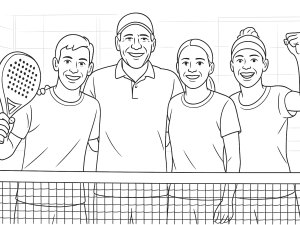
The reviewer highlights a fundamental shift in how padel is understood at the professional level, emphasizing that success on court is not solely the product of individual brilliance or the coach’s instructions. Instead, it is the result of a collaborative effort involving two players and a coach, working together as a cohesive unit. The channel stresses the importance of synchrony within the team, where ideas and strategies are shared and accepted by all members. While the coach can provide structure and tactical insight, the reviewer is clear that the unique talent and instinctive decisions of players like Ale Galán or Fede Chingotto often determine the outcome of key points—moments that are beyond the coach’s direct influence.
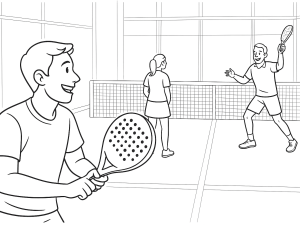
This team-centric approach is central to the methodology at M3 Academy, where the reviewer coaches some of the world’s top pairs. The academy’s philosophy is that padel is inherently a team sport, not just two individuals sharing a court. Training is conducted in groups, with a consistent system that transcends the presence or absence of any single coach. This ensures continuity and collective growth, even as individual personalities bring their own flavor to the process.
Technical evolution and tactical adaptation in recent years
According to the reviewer, padel has undergone significant changes in recent years, driven by advances in equipment, court surfaces, and playing conditions. Modern rackets and improved courts allow players to execute shots with greater power and precision, fundamentally altering the tactical landscape. The reviewer notes that leveraging a player’s specific strengths—such as Galán’s intensity and speed—can shift the dynamics of a match, forcing opponents to adapt or risk falling behind.
This evolution has led to a more demanding and precise style of play, where teams must constantly adjust their strategies in response to their rivals’ adaptations. The channel observes that the game is becoming faster and more nuanced, with tactical innovation playing a central role in high-level competition.
The M3 Academy’s approach to teaching padel as a team sport
The reviewer explains that the M3 Academy does not follow a rigid, individual-centric methodology. Instead, it employs a collective approach, focusing on the group dynamic while respecting each player’s unique characteristics. The academy’s motto, “from the game to the technique,” encapsulates this philosophy: players are taught to understand the game as a whole before refining their technical skills to suit their physical and mental profiles.
Rather than drilling technique in isolation, the academy prioritizes teaching players how to make effective decisions on court—where to place the ball, how to exploit opponents’ weaknesses, and how to maximize their own strengths. This adaptive, player-centered model is designed to foster both individual growth and team success.
As the reviewer puts it, “alone you may arrive faster, but together you go further.” This belief underpins the academy’s commitment to group training and shared learning experiences.
Challenges and benefits of unified versus split coaching setups
The reviewer addresses the growing trend of players working with separate coaches or training in different academies. While acknowledging that logistical realities sometimes necessitate this arrangement, the channel expresses a clear preference for unified team training. In the ideal scenario, both players and their coach (or coaching team) work together consistently, building a shared tactical language and mutual understanding.
When circumstances force a split, the reviewer recommends at least forming a temporary alliance between coaches to maintain team cohesion. Ultimately, a strong, integrated support structure is seen as essential for sustained success at the top level.
The current state of padel research and the need for deeper analysis
Despite padel’s rapid growth, the reviewer believes the sport remains understudied compared to more established disciplines. While some scientific studies and books—such as “Esto es Padel”—have begun to analyze shot selection and match dynamics, there is still a pressing need for more comprehensive research. The channel argues that a deeper understanding of the game will enable coaches to design more effective training sessions, closely aligned with the realities of competition.
To address this gap, the reviewer’s academy has established its own statistics department (M3 Lab), investing in software and expert personnel to systematically track and analyze match data. The goal is to build a robust dataset over time, allowing for meaningful insights into both their own players’ performance and that of their rivals.
The value and limitations of statistics in padel performance analysis
While statistics are increasingly prevalent in padel, the reviewer cautions against taking raw numbers at face value. For example, knowing that Galán made 23 winners and 3 unforced errors in a match is only meaningful when placed in context—considering the opponent, the conditions, and Galán’s typical averages over a season. The channel emphasizes that statistics are most useful when used comparatively and longitudinally, helping to identify trends or anomalies that warrant deeper investigation.
- Winners: 23 (in a specific match)
- Unforced errors: 3 (in the same match)
Ultimately, the reviewer sees statistics as a valuable tool for fine-tuning coaching decisions, but only when interpreted with nuance and a holistic understanding of the match context.
Media coverage, social networks, and the spectator’s experience
The reviewer expresses skepticism about the current focus of media and social networks, which often prioritize off-court drama, partner changes, or viral moments over substantive tactical analysis. While acknowledging that not every fan needs to be a tactical expert, the channel warns that poorly used social media can distract players—especially younger ones—and erode attention spans.
Nevertheless, the reviewer celebrates padel as a spectacular sport, urging both fans and media to appreciate the athleticism, skill, and beauty on display during matches. The channel encourages a balance between entertainment and deeper engagement with the sport’s strategic dimensions.
Emerging trends: switch play and tactical flexibility
Looking to the future, the reviewer agrees with players like Martita Ortega that “switch play”—where players regularly change sides during a match—will become more common. This tactic, already used situationally by pairs like Galán and Lebrón, adds unpredictability and can disrupt opponents’ expectations. The channel predicts that as the game evolves, professional players will increasingly develop the versatility to perform at a high level on both sides of the court, leading to more dynamic and innovative matches.
Season planning and the ideal number of tournaments
When asked about the optimal number of tournaments per season, the reviewer notes that the current structure is still in flux, with last year’s calendar featuring a heavy load due to overlapping circuits. Rather than prescribing a fixed number, the channel advocates for a system that allows players to choose events strategically, optimizing performance and reducing burnout. This flexibility would enable teams to peak at key moments and maintain a high standard throughout the season.
Reflections on coaching, career longevity, and future ambitions
The reviewer shares a deep passion for coaching and teaching, describing it as a vocational calling. However, the increasing demands of the professional circuit and the personal sacrifices involved have prompted reflection on future roles. While the reviewer is committed to finishing the current season, there is interest in transitioning towards coach education and technical direction—areas seen as vital for the sport’s continued development.
Having already served as a national team coach, the reviewer feels little pull to return to that role, preferring instead to focus on broader projects that can shape the next generation of coaches and players. This commitment to education and innovation reflects the channel’s broader vision for the future of padel.