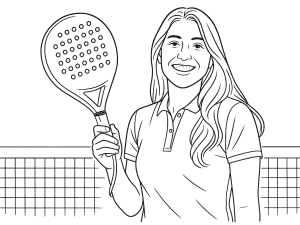
Alejandra Salazar’s journey to the top of world padel
The channel begins by highlighting Alejandra Salazar’s extraordinary record on the professional padel circuit, noting her achievement of reaching 52 victories on the World Padel Tour. This accomplishment stands out as a testament to her consistency and dominance over the years. Salazar reflects on the evolution of her career, describing how her approach and mindset have matured since her first time reaching the world number one ranking in 2009.
She draws a clear distinction between her early years and her current status. In the beginning, Salazar admits that the experience of reaching the top was almost surreal and happened quickly, partly due to a smaller pool of competitors and fewer tournaments. Back then, winning just three or four events could secure the number one spot, compared to the far more demanding and competitive environment today. She emphasizes that while there was less competition, there were also fewer resources available, making the journey unique for each generation.
Key habits and routines that define a champion
One of the central themes of the interview is the importance of habits in sustaining elite performance. Salazar shares that her evolution as a player has been marked by a growing focus on discipline, organization, and self-care. Over time, she has become much more attentive to the details that impact her performance, both on and off the court.
Among the most significant changes has been her approach to nutrition. Salazar describes how she has become highly conscious of what she eats, paying close attention to calorie intake and the quality of her food. She stresses the importance of understanding nutritional labels and being aware of seemingly small differences—such as a few extra slices of avocado—that can have a real impact on an athlete’s body composition and energy levels.
Her advice for aspiring players is to seek guidance from qualified professionals, but also to take personal responsibility for learning about nutrition and physical preparation. According to Salazar, understanding the reasons behind each habit makes it easier to maintain discipline and stick to a plan.
- Preparation: Increased focus on physical conditioning and injury prevention
- Nutrition: Careful monitoring of calorie intake and food quality
- Professional support: Working with a larger, more specialized team
- Self-education: Actively learning about health, nutrition, and recovery
The evolving demands of professional padel
Salazar and the channel discuss how the landscape of professional padel has changed dramatically over the years. The sport has become more international, especially with the rise of the Premier Padel circuit, increasing both the level of competition and the resources required to succeed. Today, players must invest in travel, coaching, and support staff, making it more challenging for those without substantial backing to break through.
She notes that while talent remains essential, the modern game rewards those who can combine skill with access to professional resources. This shift has created a new kind of pressure, as the pathway to the top now demands a greater commitment in terms of time, money, and personal development.
Training, recovery, and the importance of listening to the body
Salazar provides insight into her current daily routine, emphasizing how it has adapted to her age, experience, and physical condition. Having undergone multiple surgeries and with nearly two decades at the top level, she now prioritizes quality over quantity in her training. Recovery, both active and passive, is a central part of her regimen.
She explains that training is not limited to time spent on the court or in the gym. Sessions with physiotherapists, psychologists, and time spent analyzing matches all contribute to her overall preparation. For Salazar, these elements are just as important as technical or tactical work, especially as she manages the demands of a long career.
- On-court training: 1.5 to 2 hours per day (in pre-season)
- Physical conditioning: 1 to 1.25 hours per day
- Recovery and support: Physiotherapy, psychology, and match analysis
She highlights that the ideal training load varies depending on a player’s age, injury history, and current goals. For younger players, more hours may be necessary to develop technique, while experienced athletes like Salazar focus on maintaining peak condition and preventing injury.
Changing dynamics in padel partnerships and training
The conversation also touches on the complexities of padel partnerships. Salazar points out that not all pairs train together all the time, often due to logistical reasons or differing needs. Younger players may require more technical work, while veterans might focus on tactical preparation and physical maintenance.
This flexibility reflects the broader evolution of the sport, where individualized training plans and support systems are now the norm. The channel notes that in earlier eras, top players often had to supplement their income by giving lessons, sometimes training or teaching for up to eight hours a day before competing. Today, the professionalization of padel allows more players to dedicate themselves fully to competition, but the demands have also increased accordingly.
Key takeaways from Alejandra Salazar’s approach to excellence
- Discipline and organization are essential for long-term success
- Continuous learning about nutrition and recovery can provide a competitive edge
- Listening to the body and adapting routines is crucial, especially after injuries
- Professional support teams play a bigger role than ever in modern padel
- Quality of training often outweighs quantity, particularly for experienced players
Salazar’s story, as presented by the channel, offers valuable insights for aspiring padel players and fans alike. Her journey illustrates how the path to becoming number one is shaped by evolving habits, a willingness to adapt, and a deep commitment to every aspect of the sport—on and off the court.