How a top pro structures individual and team work
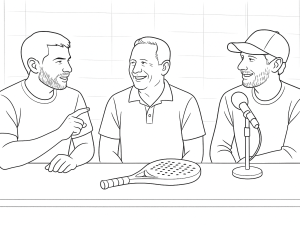
The channel sits down with Alex Ruiz to unpack what separates a professional routine from an amateur’s. The first pillar is individualization. Pros often train separately to attack personal weaknesses without compromise. In Alex’s case, that means sharpening his defense, taking calculated risks more often, and avoiding the comfort of simply “not missing.”
Only after this targeted block do they regroup as a pair to align on play designs and match strategy. The goal is simple: arrive to pressure moments with coordinated patterns, agreed triggers, and clear roles. Not everything is public—teams keep certain tactics private—but the emphasis is on being synchronized when the match turns hot.
What a typical training morning actually looks like
According to the creator, a standard morning starts at the club with a progressive warm-up: calm, controlled and building from low to high intensity. Once activated, they move into tactical drills where the coach’s planned designs are tested at pace with live balls. Depending on the day, the block can be with three or four players to stress different phases of play and positioning.
The session finishes with a freer set to let the brain decompress after heavy tactical work. It’s not aimless: the set is used to integrate the day’s concepts under looser constraints, but without the cognitive overload of constant instructions.
- Block 1: Progressive warm-up and activation
- Block 2: Tactical “play designs” with live balls (3–4 players)
- Block 3: Free set to consolidate and release tension
Weekly volume and seasonal shifts in training hours
The channel highlights a clear jump in volume compared with a decade ago. Padel’s professionalization has pulled daily loads closer to those of other high-performance sports. Alex details the spread across the year, with volume tapering as competition nears.
- Preseason daily total: around 7 hours per day
- In-season daily total: about 5 hours per day (often double shifts)
- Pre-tournament taper: roughly 4 hours per day with reduced intensity
Context matters. The week before events is lighter and more specific; the grind ramps up in preseason to build capacity and robustness. Across all phases, the balance between on-court and off-court work is now deliberate rather than incidental.
Physical conditioning load and why it now matches padel
Where older routines put most of the emphasis on-court, today’s pros split their day between padel and physical conditioning. Alex underscores how closely the sport now mirrors broader high-performance standards: mobility, strength, power, and energy-system work are non-negotiable.
- Physical training volume: typically 3–4 hours per day for pros
- Alex Ruiz’s reference: around 3 hours of physical work daily
- Structure: frequent double shifts (padel + physical)
This shift isn’t cosmetic. It’s about taking the body “to the extreme” safely, building the repeatability needed to execute under tournament stress, and protecting joints and soft tissue from chronic overload.
Injury prevention as the cornerstone for progression
When asked what most accelerates the jump from amateur to pro, Alex is unequivocal: injury prevention. Without consistent health, training quality and match rhythm collapse. Prevention is both physical and technical—cleaner mechanics reduce load, and stronger tissues tolerate it better.
He recommends working with qualified professionals who can audit specific risk areas, design corrective strategies, and monitor progression. Better to invest early in stability, mobility, and technique than lose months to avoidable setbacks.
Using training matches to simulate tournaments and test ideas
Training matches serve multiple goals. Players try to reproduce tournament tension even if stakes can’t fully match the real thing. Within that frame, the pair introduces new tactical ideas, assesses whether they hold under pressure, and decides which patterns to keep under wraps so rivals don’t get an advance scouting report.
There’s also a diagnostic angle. Facing strong opposition lets the team observe how others are playing—pace, patterns, preferred entries—and adjust their own plans accordingly.
Key takeaways for amateurs aiming at professional standards
- Prioritize individual weakness work before pairing for tactics.
- Build sessions around a warm-up → tactical → free set flow.
- Match your phase: 7 hours in preseason, 5 hours in season, 4 hours pre-event.
- Treat the gym as equal to the court: aim for 3–4 hours physical, tailored to your needs.
- Make injury prevention non-negotiable; work with professionals for screening and programming.
- Use training matches to simulate tournament pressure and to test, not show, your best ideas.
The creator’s conversation with Alex Ruiz makes one theme unmistakable: professionalism is a system, not a slogan. When individual development, tactical clarity, physical robustness, and smart match rehearsal align, the gap between amateur ambition and pro execution narrows fast—and stays that way when it matters.