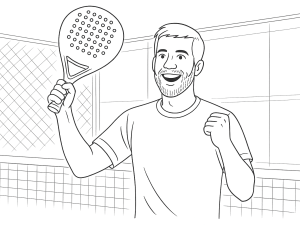
Key features of the Nox TL10 Quantum rackets for Tino Libaak and Leo Augsburger
The channel Padel Chiquito reviews the Nox TL10 Quantum padel rackets designed for Tino Libaak and Leo Augsburger, two rising stars on the professional circuit. Both rackets share a similar construction in terms of materials and core, but differ in shape and on-court performance. The review highlights how these rackets, now in surplus due to a recent controversy, might soon be available at attractive prices.
- Face material: 12K carbon fiber
- Core: HR foam (same as used in Miguel Lamperti’s racket)
- Shape (Libaak): Hybrid
- Shape (Augsburger): Diamond
Comparing the hybrid and diamond shapes: control versus power
The most significant difference between the two models is their shape. The Libaak TL10 Quantum uses a hybrid format, resulting in a medium balance and a focus on control. This makes it suitable for players who want more precision and stability in their defensive game. The reviewer notes that, despite the 12K carbon fiber construction, the hybrid model still offers a medium touch and a noticeable boost in power on fast shots, but its primary strength lies in helping players manage defensive situations effectively.
On the other hand, the Augsburger TL10 Quantum features a diamond shape with a slightly higher balance. This design makes the racket feel a bit more head-heavy (“cabezona”), which translates to greater aggression and power, especially when hitting with force. The reviewer points out that this model responds very well defensively, but the feel is drier and the ball is less perceptible on contact compared to the Libaak version. Still, when power is needed, the Augsburger delivers with impressive ball exit speed.
Materials and feel: 12K carbon fiber and HR core
Both rackets are built with a 12K carbon fiber face and an HR foam core, a combination that is also found in the racket of Miguel Lamperti. This setup provides a medium touch—neither too soft nor too hard—giving players a reactive feel on contact. The reviewer emphasizes that the HR core makes the rackets more responsive than the Nox AT10 Genius by Agustín Tapia, especially in terms of ball exit and reactivity.
While the 12K carbon fiber adds a layer of power, it does not compromise control, especially in the Libaak hybrid model. The Augsburger’s diamond shape, paired with the same materials, leans more toward power and a drier sensation, which some aggressive players may prefer.
Performance on court: defensive play and attacking shots
The reviewer provides clear feedback on how each racket performs in different game situations. The Libaak TL10 Quantum stands out in defensive scenarios, where its hybrid shape and medium balance help players recover position and control difficult balls. The medium touch and responsive core also allow for quick transitions from defense to attack, making it a versatile choice for all-court players.
The Augsburger TL10 Quantum, with its diamond shape and higher balance, is described as slightly more challenging to maneuver but excels when it comes to finishing points. The reviewer notes its superior power output compared to the Nox AT10 Genius, especially when the player applies force. However, the drier touch and less pronounced ball feel may not suit everyone, particularly those who prioritize control over raw power.
Comparison with the Nox AT10 Genius by Agustín Tapia
Both TL10 Quantum models are compared to the popular Nox AT10 Genius by Agustín Tapia. The reviewer observes that the Augsburger version, in particular, offers more power than the AT10 when hitting hard, thanks to its diamond shape and higher balance. The Libaak model, while not as aggressive, provides a more balanced experience with added control, making it a strong alternative for players who found the AT10 too focused on attack.
This comparison is especially relevant for players considering an upgrade or a switch from the AT10, as the TL10 Quantum rackets offer a different blend of control and power, tailored to the playing styles of Libaak and Augsburger.
Potential value and future availability of the TL10 Quantum rackets
Due to recent changes involving the players’ contracts and the resulting surplus of rackets with their names, the reviewer suggests that these Nox TL10 Quantum models may soon be available at reduced prices. This presents an opportunity for players to acquire high-quality rackets with professional-level specifications at a potential bargain.
The reviewer encourages players to keep an eye on the market, as the uncertainty surrounding Nox’s inventory could lead to significant discounts or even giveaways. For those seeking a blend of modern materials, professional design, and a choice between control (Libaak) and power (Augsburger), these rackets are worth considering in 2025.
Summary of key evaluations from the review
- Libaak TL10 Quantum: Excellent control, medium balance, strong defensive performance, medium touch, responsive core.
- Augsburger TL10 Quantum: More power, higher balance, drier feel, excels in attacking shots, slightly less ball feel.
- Both rackets: 12K carbon fiber face, HR foam core, professional build quality, potential for exceptional value due to surplus stock.
- Compared to Nox AT10 Genius: Augsburger offers more power; Libaak provides a more balanced, control-oriented alternative.
Players looking for a professional-grade padel racket with either a control or power focus will find both TL10 Quantum models compelling, especially as market dynamics may soon make them more accessible than ever.