Key features and construction of the Nox AT10 Pro Cup Hard 2025
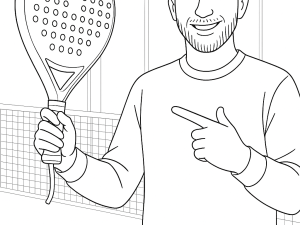
The reviewer begins by highlighting the Nox AT10 Pro Cup Hard 2025 as an evolution within the AT10 line, focusing on new design elements and materials. The racket features a rope-style wristband with improved durability thanks to a military seam on the inside and a new rubber piece for better adjustment. The Smart Strap system allows for quick and easy replacement of the wrist strap, and the cap now has an octagonal shape, a recent update for Nox rackets.
The handle is slightly shorter than standard, but the reinforced lower heart area compensates by allowing players to raise the overgrip further up. The racket incorporates AVS anti-vibration systems on both sides of the heart, aiming to reduce vibrations during play. The signature AT10 double diagonal reinforcement remains, contributing to the racket’s stability.
The faces are constructed from aluminized fiberglass, paired with EVA 50 rubber—the same rubber used in last year’s Nox Future model. This combination is designed to deliver a medium-soft feel, offering slightly more comfort than the AT10 18K but a bit firmer than the ML10 Pro Cup Luxury with 3K carbon. The surface includes a 3D honeycomb roughness for enhanced spin, though the texture is subtle.
- Weight: 360–375g (tested model: 362g)
- Balance: Medium, approximately 25.9–26 cm
- Face material: Aluminized fiberglass
- Core: EVA 50 rubber
- Surface: 3D honeycomb roughness
- Anti-vibration: AVS system
- Smart Strap: Interchangeable wrist strap system
Performance in defensive play and comfort at the back of the court
The reviewer notes that the Nox AT10 Pro Cup Hard 2025 excels in the defensive zone, offering exceptional maneuverability and comfort from the first rally. The racket is easy to handle and does not demand much physical effort, making it suitable for players seeking a manageable option for long matches.
Compared to the AT10 Pro Cup Comfort (which uses HR3 rubber), the Pro Cup Hard’s sweet spot is slightly smaller but still generous. The EVA 50 core, despite being labeled as “hard,” feels medium-soft due to the aluminized fiberglass face. The reviewer describes the rubber as reactive, providing good ball exit with minimal effort at medium and medium-low pace. At higher speeds, the rebound effect becomes more pronounced, similar to the sensation found in previous Nox Bahia models.
Players who do not naturally accelerate their shots will appreciate the extra help in ball speed, while those who hit harder may find it easier to lose control due to the lively rebound. The reviewer emphasizes that the racket is not overly demanding and is forgiving for players who want assistance generating depth from the baseline.
Mid-court performance: vibora and tray shots
In the mid-court, the AT10 Pro Cup Hard continues to impress with its quick handling and light feel. The reviewer finds it easy to accelerate the racket for vibora and tray shots, with little physical strain. The sweet spot remains consistent, though shots struck high on the face show a noticeable difference in rebound, more so than with the AT10 18K or 12K models.
At medium and medium-low pace, the racket delivers excellent control and depth with minimal effort. However, at a faster pace, the lively rebound can cause balls to float or overshoot if the player does not execute a proper downward motion. The reviewer suggests that players who already hit with high acceleration need to adjust their technique to maintain control, but those who adapt can leverage the rebound for more offensive play.
Overall, the Pro Cup Hard is best suited for players who want a racket that helps generate depth and speed without excessive effort, especially in the mid-court.
Volleying and net play: quick reactions and control challenges
At the net, the reviewer observes similar characteristics as in the mid-court. The racket’s fast response and maneuverability make it easy to react to volleys and quick exchanges. Direction changes are effortless, and the sweet spot provides reliable performance on most shots.
One of the standout features is the racket’s ability to produce deep volleys with almost no force, making it forgiving on off-balance or rushed shots. However, at higher speeds, the rebound effect can again make it challenging to control the ball, especially for players who naturally accelerate their volleys. The reviewer mentions a slight lack of confidence when aiming for precise, aggressive volleys, as the ball can float or go long if not carefully managed.
This section reinforces that the racket is most comfortable at medium or medium-low pace, where its assistance and control are maximized.
Finishing and smash performance: strengths and limitations
When it comes to finishing points, the AT10 Pro Cup Hard is not the top choice for pure power hitters due to its medium-soft hardness and overall format. However, the reviewer highlights two key advantages for less experienced or technically advanced players: the racket’s quick maneuverability allows for fast preparation, and the sweet spot remains forgiving even on imperfect contact.
For three-meter smashes, the racket’s lively rebound provides significant help, especially for players who struggle to generate their own power. The reviewer notes that the Pro Cup Hard offers more assistance in these situations compared to other Nox models, though for flat, powerful finishes, it may lack the punch found in stiffer rackets like the AT10 18K.
In summary, the racket is ideal for players seeking help in finishing with spin and rebound, but less so for those prioritizing maximum flat power.
Comparisons with other Nox models and ideal player profile
The reviewer draws several comparisons between the Pro Cup Hard and other Nox rackets. Against the AT10 Pro Cup Comfort, the Hard version offers better response in attack at higher pace, while the Comfort model provides even greater ball output at medium-low speeds. The AT10 18K and 12K models deliver more control and power for advanced, offensive players, but are less forgiving for those who need help generating speed or depth.
The Pro Cup Hard is best suited for players who:
- Prefer a medium-soft feel with a reactive core
- Want extra help in defensive and mid-court play
- Do not naturally accelerate their shots aggressively
- Value maneuverability and ease of use over maximum power
- Are looking for a forgiving racket for volleys and three-meter smashes
Conversely, players who already generate significant power and seek maximum control at high pace may find better options within the Nox lineup.
Summary of key qualitative evaluations from the review
- Defensive zone: Very comfortable, easy to generate depth, excellent for medium and medium-low pace
- Mid-court (vibora/tray): Quick handling, good depth, requires attention to rebound at high pace
- Volley: Fast reactions, deep shots with little effort, less control at high speed
- Finishing/smash: Helpful rebound for three-meter smashes, less suited for flat power shots
- Overall: Best for players seeking comfort, maneuverability, and assistance in generating ball speed, rather than pure power or maximum control at high pace