Testea Padel lab test explained – They do lab tests
At first glance, the numbers from Testea Padel’s lab might seem like the ultimate guide to picking your next racket. Charts, metrics, and colored dots — all neatly presented to help you choose. But here’s the problem: the lab doesn’t play padel — you do.
As passionate padel players and testers ourselves at Practica Padel, we believe it’s time to talk about the difference between lab data and real-world performance — and why blindly trusting charts might lead you to the wrong racket.
How lab tests work (and what they miss)
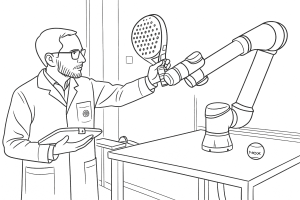
Testea Padel evaluates rackets using mechanical systems: robotic arms, pendulums, and impact sensors. They assign scores for:
- Power – based on how far a ball rebounds after a fixed-speed impact
- Sweet spot – measured as the consistency of rebound across the face
- Maneuverability – based on measured inertia
- Hardness – derived from core compression and surface deflection
That all sounds scientific — and it is. But it’s also missing the context of play.
The problems with lab-based scores
Power is not the same as smash potential
Lab power rewards rackets with soft, bouncy cores. But in real play, those rackets often lack the precision and mass transfer needed to win a point. A racket like the Nox ML10 Quantum 3K might rank high in the lab, yet feel flat during overheads.
Sweet spot is not the same as forgiveness
Testea measures how consistently the ball rebounds across the face. But what matters on court is how often you can hit that sweet spot and how the racket reacts when you don’t. A round, lower-balance racket usually feels easier to handle, no matter the data.
Maneuverability is not just numbers
Testea calculates maneuverability through swing inertia. But real-world handling also depends on the racket shape, air resistance, grip setup, and your swing tempo — factors not captured in their scoring.
Lab tests can’t measure confidence
They don’t account for fatigue, timing errors, pressure situations, or the need for consistency over a two-hour match. A racket that looks good in the lab might feel awkward under pressure — and that’s what truly matters.
Why real-world testing matters more
At Practica Padel, we go beyond static lab values. Here’s how we test:
- We play all shots: volleys, bandejas, lobs, blocks, and smashes
- We compare rackets at matched weight and balance to isolate performance
- We test on both good and bad days to reflect real experience
- We assess power, timing, comfort, and consistency — not just bounce angles
The result is practical advice that reflects actual gameplay, not just mechanical output.
What you should really trust
Use Testea’s charts as a reference point — nothing more.
Consider:
- Shape (round, teardrop, diamond)
- Core feel (soft, medium, firm)
- Balance point and swing weight
- Your style and how you feel with the racket in match play
Most importantly, trust your hand, your confidence, and your own results.
Because padel is not about which racket scores best in a lab.
It’s about which one helps you play your best when it matters.
Testea Padel measures power using a mechanical pendulum system. A ball is launched toward the racket at a fixed speed, and the system measures the rebound angle after impact. The higher the rebound angle, the higher the power score. This method favors rackets with a soft, trampoline-like core that quickly absorbs and releases energy — but it does not simulate real match conditions like smashes or overheads.
Testea Padel scores are useful as a reference point, but not as a definitive guide. They are based on lab simulations that don’t account for gameplay feel, fatigue, grip comfort, or player technique. A racket that scores well in a lab may perform very differently in real matches, especially under pressure.
Testea rates the sweet spot by analyzing how consistent the rebound is across different parts of the racket face. The larger the area with uniform rebound, the higher the score. However, this method doesn’t necessarily reflect how easy it is to find or hit the sweet spot during a fast-paced game.
Because their tests use robots — not people. They don’t account for wrist fatigue, timing, defensive situations, or awkward angles. Rackets with soft cores might score high in power but feel weak in smashes. Others may feel more maneuverable or stable than their lab scores suggest due to balance, swing weight, or materials.
Lab-tested power is based on rebound speed, not smashing potential. Real power depends on your timing, technique, racket balance, weight, and core firmness. A firm-core racket may score lower in the lab but allow much more power in overheads and aggressive play.
No. A high rating might look good on paper but doesn’t guarantee better results on court. Many players prefer rackets that feel balanced, forgiving, or confidence-boosting — even if they don’t rank highest in lab metrics. Real match play requires more than just bounce measurements.
You should use both — but rely more on real-world reviews. Testea’s lab data is helpful for understanding materials and relative performance, but it’s real testing, match play, and player feedback that reveal how a racket truly performs across volleys, lobs, smashes, and defense.