What defines a hybrid padel racket and who should use one?
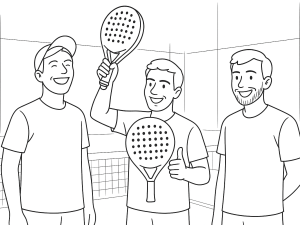
The reviewer from Mejora Tu Padel, joined by Crespo and Dani, begins by clarifying what makes hybrid padel rackets unique. These rackets are designed to offer a balance between power and control, making them suitable for players who want versatility on the court. While they may not be the absolute best in any single aspect, hybrids excel at making gameplay easier, especially for those who value both maneuverability and the ability to generate forceful shots.
Hybrid rackets are ideal for players who want to defend effectively at the back of the court but also need enough power to finish points with smashes or aggressive volleys. The channel emphasizes that these rackets are not just for advanced players; they can suit a wide range of skill levels, particularly those seeking a well-rounded tool that adapts to various situations during a match.
Key hybrid padel rackets reviewed in this comparison
The video focuses on several standout hybrid models currently available. The main rackets tested and discussed include:
- Nox AT10 12K
- Oxdog Hyper Pro 2.0 (referred to as “Hotdog” in the video)
- Fuji
- Siux
- Neuron
- Combat 975
- MM3
- OS Dani 13
- ST3
Each of these rackets brings its own blend of features, with some leaning slightly more towards power and others towards control or maneuverability. The reviewer and guests provide detailed feedback on how each model performs in different areas of the game.
Attack performance: power, sweet spot, and overheads
Crespo highlights his top picks for attacking play, focusing on rackets that deliver the desired impact and control when finishing points. He singles out the Nox AT10 12K, Oxdog Hyper Pro 2.0, and Fuji as the models that best translate his intentions into the ball. These rackets provide a satisfying combination of power and precision during smashes and overheads.
The Siux is noted for its smaller sweet spot, making it less forgiving if contact is not made in the center. The Neuron, while classified as a hybrid, is described as softer and more suited to attack than pure control, but it requires more effort to generate speed. The Nox stands out for its comfort and ease of use, especially for players who want a racket that feels natural in the hand.
For overhead shots, Crespo’s top three are the Fuji, Nox Hotdog, and OS2. He praises the Fuji for its balanced feel and the OS2 for its acceleration and medium-high balance, which aids in generating power for finishing points.
Volley and net play: handling and responsiveness
Dani offers his perspective on volleying and net play, where quick reactions and precise placement are crucial. He identifies the Oxdog Hyper Pro 2.0, Fuji, and Nox AT10 12K as the best for handling and responsiveness. These rackets are described as fast and accurate, allowing players to execute their intended shots with minimal effort.
The ST3 is noted for its higher balance, which increases ball speed but can make control more challenging. The Neuron feels softer and keeps the ball on the face longer, requiring more force to achieve the desired output. The MM3 is seen as a blend between the Fuji’s maneuverability and the ST3’s ball speed, offering a balanced option for players who want a bit of both.
Dani’s favorites for control and handling at the net are the Fuji, Nox AT10 12K, and Oxdog Hyper Pro 2.0, all of which deliver a reliable and responsive feel during fast exchanges.
Defensive play: comfort, balance, and adaptability
When it comes to defense, Manu Martín shares his preferences, emphasizing rackets that offer comfort and quick maneuverability. The Fuji and MM3 are highlighted as favorites for their ease of handling and adaptability in defensive situations. The OS Dani 13 is described as a revelation, providing exceptional speed and precision when defending, making it a standout for players who prioritize quick reactions.
The Neuron offers head-heavy balance and a softer feel, which can be advantageous for power but demands more technical skill to control. The Nox is praised for its lower balance and user-friendly comfort, making it accessible for a wide range of players. The Combat 975 is very fast in defense but lacks a bit of ball output, while the Siux leans more towards attack due to its higher balance.
An interesting feature mentioned is the Combat 975’s removable 8g piece in the handle, which allows players to adjust the racket’s balance to suit their preferences. This kind of customization can be a valuable asset for players seeking to fine-tune their defensive play.
Summary of key evaluations from the reviewers
- Best for attack: Fuji, Nox AT10 12K, Oxdog Hyper Pro 2.0
- Best for volley and handling: Fuji, Nox AT10 12K, Oxdog Hyper Pro 2.0
- Best for defense: Fuji, MM3, OS Dani 13
- Most comfortable: Nox AT10 12K
- Most customizable: Combat 975 (removable handle weight)
- Most powerful but less forgiving: Siux
- Best for technical players seeking power: Neuron
The reviewers agree that while no single hybrid racket is perfect for every player, the right choice depends on individual needs—whether that’s more control, power, or adaptability. The Fuji consistently receives high marks across all areas, while the Nox AT10 12K and Oxdog Hyper Pro 2.0 stand out for their comfort and handling. The Combat 975’s adjustable balance is a unique feature for those who like to fine-tune their gear.