Technical specifications and design details of tactical padel el capitan
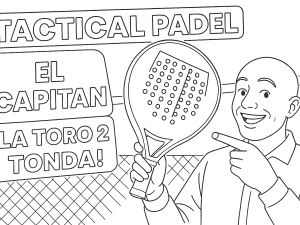
The reviewer introduces the Tactical Padel El Capitan as a standout addition to the brand’s 2024 lineup, describing it as the “bad sister” of the well-known El Jefe model. While the two rackets share a nearly identical shape, El Capitan distinguishes itself through its materials and core construction. The racket features a carbon kevlar frame and 12K carbon fiber faces, mirroring the premium build of Tactical’s top models.
- Weight: 355g (tested model), with a range of 355–375g
- Balance: 26 cm (lower than El Toro, similar to El Jefe)
- Core: EVA 30 (not the five-layer hybrid core found in El Jefe)
- Shape: Rounded drop (“tonda goccia”), with a high shoulder
- Face material: 12K carbon fiber
- Frame: Carbon kevlar
Visually, the El Capitan stands out with its elegant, slightly faded blue color and a clean, minimalist design. The reviewer notes the aesthetic appeal of the white handle, which complements the blue finish. The handle length is 12.5 cm, and the overall build quality is described as simple yet highly effective.
Comparing el capitan to el jefe and other tactical padel models
Throughout the review, the creator frequently compares El Capitan to its “sister” racket, El Jefe. While both rackets share a similar silhouette, the differences in core and frame materials create distinct on-court sensations. The El Capitan is described as more powerful and solid, with a slightly heavier feel in the hand despite its lower weight compared to the reviewer’s own El Jefe (which weighed 361g or 359g).
One key distinction is the sweet spot: El Capitan’s is a bit smaller and more centered, requiring greater precision, whereas El Jefe offers more forgiveness, especially on higher impacts near the tip. This translates into El Jefe being slightly easier in defensive play, while El Capitan rewards a more technical, aggressive approach.
The reviewer also draws parallels between these Tactical models and popular Nox rackets, suggesting that the difference between El Capitan and El Jefe is similar to that between the AT10 and AT2 from Nox, but with more energy and power in the Tactical models.
On-court performance: power, control, and feel
El Capitan delivers a blend of power and solidity that stands out in its category. Despite its relatively light weight of 355g, the racket feels substantial and stable during play. The reviewer highlights its “full ball output,” meaning that shots leave the racket with notable force and depth, especially when the player engages the core with proper technique.
The core is described as medium in feel—not too stiff, not too soft—requiring a minimum level of activation from the player. This makes El Capitan less suitable for absolute beginners, but highly rewarding for players with solid technique who can take advantage of its energetic response. The racket’s stability is praised, with the reviewer noting that it remains composed even during fast exchanges and powerful shots.
Control is another strong point, with the racket offering a progressive response that allows players to direct the ball with confidence. The reviewer notes that El Capitan is slightly more sensitive than El Jefe, providing better feedback and a more connected feel on contact.
Spin, volleys, and technical strokes
Spin generation with El Capitan is described as “very good,” though not at the level of rackets with extreme surface roughness. The racket rewards players who can impart spin through technique rather than relying solely on the racket’s surface. For advanced players, this is not a drawback; however, those still developing their spin mechanics may find it less forgiving.
On volleys, El Capitan shines with its maneuverability and responsiveness. The reviewer finds it easy to move and effective for aggressive net play, provided the player uses intentional, technically sound strokes. The racket’s sweet spot, while not the largest, is sufficient for consistent performance, and its mass allows for deep, complex volleys without excessive effort.
The vibora is another area where El Capitan excels. The reviewer appreciates the racket’s ability to generate pace and spin, describing it as “very well connected to the force applied by the arm.” This quality instills confidence and encourages players to experiment with more aggressive, spin-heavy shots.
Smash and wall exit: aggressive play with manageable effort
When it comes to smashes, El Capitan is characterized as the “meaner” version of El Jefe. The flat smash is described as “concrete”—not the most explosive in the Tactical lineup (that honor goes to the Katana Red), but still powerful and effective when executed with proper technique. The reviewer notes that the racket’s energy and full ball output make it easy to generate pace on both flat and kick smashes, especially at medium to high swing speeds.
Wall exits are another highlight, with the racket providing aggressive, controlled responses even at moderate effort levels. The reviewer is impressed by how much depth and speed the ball gains off the glass, attributing this to the racket’s mass and balance.
Despite its power, El Capitan remains manageable, never feeling wild or unpredictable. This balance between aggression and control makes it suitable for players who want to play assertively without sacrificing stability or comfort.
Comfort, maneuverability, and ideal player profile
Comfort is a recurring theme in the review. Despite its solidity and energetic response, El Capitan is not harsh on the arm. The reviewer, who typically avoids heavier rackets, finds it surprisingly easy to handle and appreciates its agility, especially compared to the heavier Katana Red.
Manoeuvrability is rated highly, with the racket moving quickly through the air and responding well to fast-paced exchanges at the net. The reviewer emphasizes that while El Capitan is accessible, it does require a certain level of technical skill to unlock its full potential. Players who can provide precise, intentional strokes will benefit most from its characteristics.
In summary, El Capitan is best suited for intermediate to advanced players seeking a racket that combines power, stability, and a responsive feel, without being overly demanding or specialized.
Reviewer’s ratings for tactical padel el capitan
- Ball output: 8 (full, substantial, not overly easy)
- Sweet spot: 7.5 (centered, a bit smaller than El Jefe)
- Control: 8 (progressive, never escapes control)
- Power: 7.75 (strong, but Katana Red is more powerful)
- Maneuverability: 7.5 (moves very well)
- Comfort: 8 (comfortable despite solidity)
- Feel: 7.5 (good, could be slightly crisper)
- Spin: 7.5 (good, but requires technique)
- Stability: 7.5 (surprisingly stable for the weight)
- Play from the back: 8 (complete, requires some activation)
- Wall exit: 8.5 (aggressive, substantial response)
- Volleys: 7.75 (effective, would prefer more tip work)
- Flat smash: 7.5 (solid, needs arm engagement)
- Kick smash: 8.5 (excellent, full ball output)
Key takeaways and who should consider el capitan
The Tactical Padel El Capitan stands out as a powerful, stable, and versatile racket that rewards players with solid technique. Its blend of 12K carbon fiber, carbon kevlar frame, and EVA 30 core delivers a unique feel—substantial yet comfortable, energetic yet controlled. The reviewer highlights its suitability for aggressive, technically proficient players who want a racket that can keep up with fast-paced, spin-heavy play while remaining manageable and comfortable for long sessions.
Players seeking a forgiving, beginner-friendly racket may find El Capitan slightly demanding, but those looking for a step up in power, stability, and feedback will appreciate its qualities. The reviewer concludes that El Capitan is a “complete and concrete” racket that exceeds expectations, especially for those who value a blend of power and control in a modern, elegant package.